

There’s nothing quite like that sinking feeling on a sweltering Georgia day when you realize your AC is blowing hot air. It’s more than just an annoyance; it’s an urgent call for help from your HVAC system. Sometimes, the fix is refreshingly simple, like a wrong thermostat setting. Other times, it’s a red flag for a bigger problem, like a refrigerant leak that needs a pro from Top Tech Mechanical.
Your AC Is Blowing Hot Air. Now What?
That first gust of warm air is always a bit of a shock. But before you panic, it helps to understand what’s actually going on. Think of your air conditioner as a "heat sponge." Its entire job is to soak up all the heat inside your home and wring it out outside, leaving you with cool, comfortable air. When it starts blowing hot, that heat-transfer process has broken down somewhere.

This failure can happen for a handful of reasons. Maybe the system can't "breathe" because of a dirty air filter, or the outdoor unit is so caked with grime it can't get rid of the heat it's collected. It could also mean the refrigerant—the very lifeblood of the cooling process—is running low from a leak.
A Quick Diagnostic Checklist
For homeowners in Kennesaw, Marietta, and Roswell, figuring out the cause is the first step toward getting cool again. Some issues are easy DIY fixes, but others need a certified technician to avoid turning a small problem into a big one. Before you pick up the phone, run through this quick guide to see what you might be dealing with.
When your AC stops cooling, it's telling you something important is broken. If you just let it run, you risk turning a straightforward repair into a full, and much more expensive, system replacement.
To help you troubleshoot, we’ve put together a table of the most common culprits. Use this to determine if you’re facing a five-minute fix or if it’s time to call Top Tech Mechanical for professional AC repair.
Common Reasons Your AC Blows Hot Air
Use this quick-reference table to diagnose potential issues and determine if you need a DIY fix or professional service.
| Potential Cause | Key Symptoms | DIY Fix or Professional Help? |
|---|---|---|
| Incorrect Thermostat Setting | The fan is running, but the air coming out isn’t cold. | DIY Fix: Check that the thermostat is set to "COOL" and the temperature is lower than the current room temperature. |
| Clogged Air Filter | Airflow from the vents feels weak; the system seems to be struggling or running constantly. | DIY Fix: This is the #1 culprit. Inspect your air filter and replace it if it's dirty. |
| Dirty Outdoor Condenser Unit | The outdoor unit's fan is spinning, but the air it’s pushing out isn't warm. You might see visible dirt, leaves, or grass clippings on the fins. | DIY Fix (with caution): You can gently rinse the unit with a garden hose (don't use high pressure!). If the fan isn't spinning or it needs a deep clean, call a pro. |
| Refrigerant Leak | You hear a hissing sound near the unit, see ice on the copper lines, or the system runs nonstop without cooling the house. | Professional Help: Refrigerant is a hazardous material. Only a certified HVAC technician can legally and safely handle it. |
| Electrical Issues | The system won’t turn on at all, or it keeps tripping the circuit breaker. | Professional Help: Besides flipping a breaker once, any electrical troubleshooting is a job for an expert. It's a major safety risk otherwise. |
Working through these initial checks will give you a much clearer idea of what’s going on. This helps you take the right next steps, saving you time and stress when all you want is to be comfortable in your own home again.
The Most Common Culprit: A Clogged Air Filter
Before you start imagining a catastrophic system failure, let’s talk about the single most common reason your AC is blowing hot air: a clogged air filter.
This simple part is your HVAC system’s first line of defense against dust, dirt, and debris. When you neglect it, you’re basically asking your system to breathe through a straw while running a marathon. Eventually, it just can't get enough air to do its job.
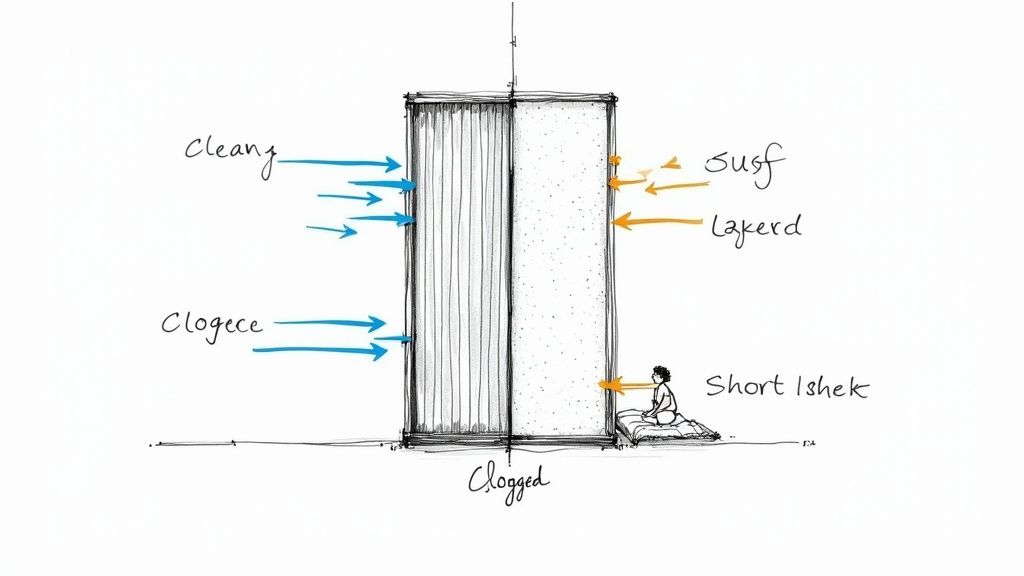
This lack of airflow triggers a domino effect. Inside your AC’s indoor unit is an evaporator coil, which is responsible for absorbing heat from your home’s air. When a dirty filter blocks air from flowing over it, the coil can’t work properly. It gets way too cold, and the condensation on its surface freezes solid.
Once the evaporator coil is frozen, it’s just a block of ice. No heat can be removed from the air. Your system’s fan will keep running, but now it’s just pushing air past that ice and through your vents, giving you lukewarm air instead of the cool relief you’re expecting.
This problem is incredibly common. Roughly 90% of homes in the United States have air conditioning, which means changing a filter is a critical piece of maintenance for millions of families. It's one of the simplest ways to keep these vital systems running efficiently.
How to Inspect and Replace Your Air Filter
For homeowners in Acworth, Canton, and Woodstock, checking your air filter is a quick task that can save you from a sweltering home and an unnecessary service call. This should always be your first step.
-
Find Your Filter: It's usually in one of two places: either in a slot on the indoor air handler unit (often found in a closet, attic, or basement) or behind a large return air vent on a wall or ceiling.
-
Check for Dirt: Slide the filter out and hold it up to a light. Can you see light through it? If not, it’s completely clogged and needs to be replaced right away. A filter packed with dust and pet dander is choking your system.
-
Get the Right Replacement: The filter's size is printed right on its cardboard frame (e.g., 16x25x1). Always buy the exact same size. An ill-fitting filter allows dirt to sneak past it and get into your system, causing bigger problems down the road.
For more detailed instructions, check out our guide on how to change your HVAC air filter. This simple piece of AC maintenance is the easiest way to prevent a whole host of cooling issues.
When your AC decides to pump out hot air on a sweltering Georgia day, it's natural to jump to the worst conclusion. You start picturing a catastrophic failure and a hefty repair bill. But hold on a second. More often than not, the culprit isn't some major component inside the AC unit, but something much simpler: the thermostat and its power source.
Think of your thermostat as the mission control for your entire HVAC system. If the signals from mission control are off, the rest of the equipment can't do its job right. Before you give us a call for a service visit in Dunwoody or Sandy Plains, running through these quick checks could have you back to cool in just a few minutes.
Start with the Simple Thermostat Settings
It sounds almost too simple, but you'd be surprised how often a hot air problem comes down to the wrong thermostat setting. A family member might have bumped it, or a brief power flicker could have reset it. It's always the first and easiest place to look.
- Confirm the Mode: Make sure your thermostat is switched to "COOL." If it’s on "HEAT," "FAN," or "OFF," you're not going to get any cooled air. The "FAN" setting, for instance, just blows room-temperature air around, which will definitely feel warm when it's hot outside.
- Check the Temperature: The temperature you set has to be lower than the current temperature in the room. If your house is 80°F but the thermostat is set to 82°F, the air conditioner has no reason to turn on. It's just waiting for instructions.
If you've confirmed the settings are right but there's still no cool air, the next step is to see if the thermostat has power.
Checking for Power and Connection Issues
A thermostat without power is like a TV remote with dead batteries—it can't send any commands to your air conditioner. Many modern digital thermostats run on batteries, and when they die, the communication link to your HVAC system is completely severed.
A blank thermostat screen is a dead giveaway for a power problem. But even a faint or glitchy display can mean the batteries are too low to send a strong enough signal to kick on the AC.
Most thermostat covers pop right off, giving you easy access to the battery compartment. Swap them out with a fresh set and see if that brings your system back to life. If your thermostat is hardwired directly into your home's electrical system, the problem might be at the breaker box.
Safely Inspecting Your Circuit Breakers
Your HVAC system is a powerful piece of machinery and runs on its own dedicated circuits. If one of those circuits trips, it cuts the power to either your indoor or outdoor unit (or sometimes both), stopping the cooling process cold. Here’s how to check it safely.
- Locate Your Breaker Box: Find your home's main electrical panel. It's usually tucked away in a garage, basement, or utility closet.
- Look for Tripped Breakers: Scan the rows of switches. A breaker that has tripped will either be in the "OFF" position or, more commonly, stuck in a neutral position between "ON" and "OFF."
- Reset the Breaker: To reset it, you need to push the switch firmly to the full "OFF" position first, and then flip it back to "ON." You should only try this once. If it trips again right away, that's a sign of a deeper electrical issue that needs a professional for an AC repair.
One last thing to check is the outdoor disconnect switch. This is a small box usually mounted on the wall near your big outdoor condenser unit. Sometimes it gets switched off by mistake during yard work. Just make sure it's flipped to the "ON" position, and you might have just found the simple fix to get cool air flowing again.
Taking a Look at Your Outdoor Condenser Unit
After you've ruled out the thermostat and power issues, your next stop is outside. The outdoor condenser unit is the real workhorse of your air conditioning system. Its whole job is to take the heat your AC pulls from inside your home and dump it into the Georgia air. If that process fails, the heat has nowhere to go but right back through your vents.
A good way to think about the condenser is like the radiator in your car. A radiator gets rid of engine heat to stop it from overheating; your condenser does the exact same thing for your home. When it gets clogged with dirt, leaves, or grass clippings, it can't "breathe" and essentially suffocates, leaving you with an AC that blows hot air.
For homeowners in Dallas, Powder Springs, and Hiram, a quick walk around this unit can often solve the mystery. A clean condenser is an efficient one, and keeping it clear is a huge part of routine AC maintenance.
Your Outdoor Unit Inspection Checklist
First thing's first: turn off the power to the unit. You have to do this in two places to be safe. Start at your main circuit breaker panel inside, then find the disconnect switch—it's a small metal box usually mounted on the wall right next to the condenser—and shut it off, too. Once you're sure the power is off, you can get started.
- Look for Blockages: Scan the unit for any obvious debris. Over the year, things like cottonwood fluff, lawn clippings, and leaves get sucked against the unit, forming a blanket that completely blocks the delicate metal fins.
- Check the Fins: Those thin, metal grilles wrapped around the unit are the condenser fins. They need to be straight and evenly spaced. If big sections are bent or smashed flat, it's like trying to breathe with a stuffy nose—the airflow is seriously restricted.
- Inspect the Fan: The big fan on top is what pulls air through the coils. Make sure the blades are clean and that nothing is physically stopping them from spinning freely.
If the unit is just layered with light dust or grass, you can probably clean it yourself. Just grab a garden hose with a gentle spray nozzle—never, ever use a pressure washer—and rinse the fins from the top down. You’d be surprised what a difference this simple cleaning can make.
Temperature plays a huge role in how much electricity we use, especially for heating and air conditioning. It turns out there's a "sweet spot" for minimal energy use, right around 58.3°F, where neither heating nor cooling systems have to work very hard. You can learn more about how weather and energy are connected from the International Monetary Fund.
DIY Maintenance vs Professional AC Service
While a little bit of outdoor cleaning is a great DIY task for homeowners, many issues are best left to a certified technician. Knowing where to draw the line can save you from a costly mistake or, worse, an unsafe situation.
Here's a quick comparison to help you decide whether to tackle a task yourself or call in the pros.
| Task | DIY Difficulty | When It Requires a Professional |
|---|---|---|
| Rinsing the Coils | Easy | This is a perfectly safe DIY task as long as you use a gentle hose spray and the unit is just moderately dirty. If the coils are caked in grime or you see any ice, it’s time to call us. |
| Clearing Debris | Easy | You can definitely trim back shrubs and clear leaves from around your unit. Just make sure to leave at least two feet of clear space on all sides for proper airflow. |
| Straightening Fins | Medium | You can find a special "fin comb" at a hardware store to gently straighten bent fins. If the damage is widespread or the fins are deeply bent, a professional cleaning is a much better option. |
| Checking the Fan Motor | Professional Only | If the fan isn't spinning when the unit should be running, it usually points to a failed capacitor or a bad motor. This is an electrical repair that absolutely requires a licensed technician. |
If you’ve hosed down the unit and your AC still blows hot, or if you noticed the fan isn't working at all, that's your cue to call for professional AC repair. These are signs of a more complex problem that goes beyond simple cleaning.
The team at Top Tech Mechanical has the right tools and training to diagnose and fix these issues safely, getting cool air back into your home fast.
Alright, you've handled the easy stuff—you checked the thermostat, swapped the air filter, and even cleared away the debris from your outdoor unit. But your AC is still pushing out warm air. What gives?
When the simple fixes don't work, it usually means the problem is a bit deeper, often pointing to the system's refrigerant. This is the lifeblood of your air conditioner, and when it’s low, it kicks off a chain reaction that leads to two major issues: leaks and a frozen indoor coil.
A lot of people think refrigerant is like gas in a car—that it just gets "used up" over time. That's a myth. Your AC system is a sealed loop, so if the refrigerant level is low, it means you have a leak somewhere.
How a Leak Leads to a Block of Ice
A refrigerant leak is more than just an inconvenience; it’s a critical failure. As refrigerant escapes, the pressure inside the system plummets. This sudden drop in pressure causes the temperature of the indoor evaporator coil to nosedive, getting far colder than it should.
All that moisture in your home's air, which normally condenses and drips away harmlessly, now freezes solid onto the super-chilled coil. Layer by layer, ice builds up until the entire coil is a solid block.
Once that happens, air can't pass through to be cooled. Your fan is still running, pushing air through the vents, but since the coil is just a chunk of ice, the air that comes out is lukewarm at best.
A frozen evaporator coil is the classic tell-tale sign that a refrigerant problem is why your AC is blowing hot air. Letting the system run like this is a recipe for disaster—it can destroy your compressor, turning a straightforward repair into a full-blown system replacement.
The key is to catch the signs of low refrigerant early. Here’s what homeowners in Marietta, Mableton, and Smyrna should be on the lookout for:
- Hissing or Bubbling Noises: Strange sounds from your AC unit are often the sound of refrigerant escaping. To learn more, check out our post on what a hissing sound from your AC could mean.
- Ice Where It Shouldn't Be: You might see frost or ice forming on the copper lines running to your outdoor unit or on the indoor coil itself.
- It Just Won't Cool Down: Your AC runs for what feels like forever but can’t seem to get your home to the set temperature.
- Sudden Spike in Energy Bills: If your power bill jumps without explanation, it could be your AC working overtime to make up for the refrigerant loss.
This guide shows how a blocked outdoor unit can also contribute to the problem, putting extra strain on your system.

As the infographic shows, things like overgrown bushes, dirty fins, or a bad fan motor all prevent your AC from getting rid of heat effectively, which only makes existing problems worse.
This Is Not a DIY Fix—Here’s Why
Let me be direct: handling refrigerant is a job for certified professionals, period. It's a regulated chemical, and by federal law, only EPA-certified technicians with specialized equipment are allowed to work with it. Trying to "top it off" yourself isn't just illegal—it's dangerous.
When you call Top Tech Mechanical for an AC repair in Roswell or Kennesaw, our pros have a specific, proven process:
- Find the Source: We use professional-grade leak detection tools to find exactly where the refrigerant is escaping.
- Fix the Leak: We repair the compromised line or component to create a permanent seal.
- Charge It Right: Only after the leak is fixed do we recharge the system with the exact amount of refrigerant specified by the manufacturer.
Just adding more refrigerant without fixing the leak is like pouring water into a bucket with a hole in it. It's a waste of money, bad for the environment, and the problem will just come right back. For a real, lasting solution, trust the licensed team at Top Tech Mechanical.
When To Call for Professional AC Repair
While it’s great to tackle home projects yourself, there's a clear line in the sand when it comes to AC repair. Some issues just aren’t meant for a DIY approach. They demand the specialized tools, in-depth training, and safety know-how that only a certified HVAC technician brings to the table. Our expertise also extends to commercial rooftop AC repair and heating installation.
Trying to fix these complex problems on your own can be risky. You could easily turn a small, fixable issue into a catastrophic system failure—and a much bigger bill.
Knowing when to step back and call for help is key. If your ac blows hot after you’ve already checked the simple stuff like the filter or thermostat, that’s a big sign the problem is deeper. Letting the system keep running like that can cause serious damage to its most expensive parts.
Signs You Need an Expert Immediately
For homeowners in Cumming, Milton, and Johns Creek, spotting these red flags can save you a world of headache and money. If you notice any of these things happening, it’s time to give Top Tech Mechanical a call.
- Suspected Refrigerant Leaks: Like we mentioned, low refrigerant always points to a leak. If you hear a hissing sound, see frost on the copper lines, or your AC just won't stop running, you need an EPA-certified pro.
- Persistent Electrical Issues: Resetting a tripped breaker is one thing. If it trips again right away, you're dealing with an electrical fault. This is a serious fire hazard and definitely not a DIY job.
- Loud or Unusual Noises: Any grinding, squealing, or banging is a cry for help from your AC. These sounds often mean a motor is failing or the compressor is in trouble, and ignoring them can lead to a complete breakdown.
- The Fan Isn't Spinning: If the outdoor unit is dead silent and the fan blades aren't moving, it’s likely a bad capacitor or a burnt-out fan motor. Both of these parts need to be replaced by a professional.
Attempting to fix complex electrical faults or handle refrigerant without certification is not only dangerous but can void your system's warranty. A professional repair ensures the job is done safely, correctly, and according to local codes.
A struggling HVAC system doesn't just fail to cool; it wastes a massive amount of energy. Globally, air conditioning uses about 2,100 terawatt-hours of electricity, which has a real impact on greenhouse gas emissions. A faulty unit has to work much harder, sending your utility bills through the roof. You can learn more about energy consumption from Our World in Data to see the bigger picture.
When your AC is blowing hot air and the cause isn't something simple, the safest and smartest move is to call for professional AC repair. Our certified team at Top Tech Mechanical has the expertise to find the real problem and deliver a solution that lasts. To get started, you can find more information about finding a local HVAC repair service near you on our site.
Your Top Questions About AC Problems, Answered
When your AC gives you the cold shoulder by blowing hot air, the questions start flying. What’s going on? Is this a big deal? What should I do? We hear these all the time from homeowners in Marietta, Powder Springs, and the entire metro Atlanta area, so we’ve put together some straight-forward answers to help you out.
How Often Should I Really Change My Air Filter?
The standard answer is every 1-3 months for a typical 1-inch filter. But honestly, that's just a starting point.
If you've got pets leaving a trail of fur or family members with allergies, you should be checking it monthly. Here in Georgia, especially in high-pollen spots like Kennesaw or Cartersville, filters get dirty fast. Keeping that filter clean is the easiest and cheapest thing you can do to prevent airflow issues that make your whole system work way too hard.
Can I Just Top Off My AC with Refrigerant?
Absolutely not. Think of it this way: refrigerant isn't like gas for your car; it doesn't get "used up." If it's low, there's a leak somewhere in the system—end of story.
Refrigerant is a federally regulated chemical that requires an EPA-certified pro with special tools to handle safely. A Top Tech Mechanical technician will find and fix the leak first, then recharge the system to the exact level the manufacturer requires. Simply adding more is like putting a band-aid on a problem that needs stitches. It’s a temporary fix that wastes money and doesn’t solve the real issue.
Your AC's refrigerant system is sealed. If your car tire has a slow leak, you don't just keep adding air every morning and hope it holds. You find the nail and patch the hole. It's the same logic—fix the leak first for a real, lasting solution.
Why Does My AC Blow Hot Air Only Sometimes?
This on-again, off-again cooling is a real head-scratcher, but it usually points to a few common culprits. The number one cause we see is an evaporator coil that's freezing into a block of ice and then slowly thawing out. This creates a frustrating cycle of warm air, then cool air, then back to warm.
Another possibility is your outdoor unit is overheating on those brutal Georgia afternoons and shutting itself down to avoid damage. It could also be a shaky electrical part, like a capacitor that's struggling to give the fan motor a consistent jolt to start. Since it’s tough to know for sure without the right diagnostic gear, your best bet is to have a certified technician from Top Tech Mechanical take a look. We also handle heating repair and water heater repair for year-round comfort.
Is My AC Blowing Hot Air an Emergency?
On a sweltering July day in Georgia, it sure feels like one! From a technical perspective, it’s definitely an urgent problem that needs to be addressed quickly.
If the root cause is something serious like a failing compressor, letting the AC run can turn a repair job into a full system replacement. We always recommend turning the cooling function OFF at your thermostat to prevent any more damage. If you think the coil might be frozen, you can leave the fan set to "ON" to help it thaw out faster. Then, give a professional a call to make sure a small problem doesn't become a huge, expensive one.
Don't let a temperamental air conditioner take over your summer. If you're dealing with AC issues and need reliable AC repair or AC service, the certified experts at Top Tech Mechanical are here to help. We’re proud to serve Kennesaw, Acworth, Woodstock, and the greater Atlanta area with honest advice and solutions that last. We also specialize in commercial AC services, duct cleaning, and improving your indoor air quality.
Schedule your service today by visiting us at https://dev.toptechmech.com.