

When you're trying to find the best humidifiers for home, the answer really depends on what you're trying to achieve. If you want a seamless, set-it-and-forget-it solution for your entire house, a whole-house unit that works with your HVAC system is the gold standard. For specific rooms, you can't go wrong with top-rated portable models from trusted brands like Levoit and Honeywell.
Ultimately, the right choice is about balancing your home's unique layout with your family's health needs.
Why Your Home's Humidity Is a Hidden Health Factor
You know that dry, scratchy feeling that settles into your home during the colder months? It’s more than just a minor annoyance—it’s a clear sign that your home's air is seriously out of balance.
This dryness can wreak havoc on your health, your comfort, and even the wood floors and furniture in your house. Think of your home's air like a dry sponge. When it lacks moisture, it gets desperate and starts trying to soak it up from anywhere it can find it.
That means it pulls moisture right out of your body and your belongings. The result is a whole cascade of uncomfortable and damaging effects that we see all the time in homes across the Atlanta area, from Kennesaw and Acworth to Roswell and Woodstock.
The Impact of Dry Indoor Air
Once your indoor humidity drops below 30%, you’ll really start to notice the consequences. This lack of moisture in the air kicks off a variety of issues that affect both your well-being and your property.
- Health and Comfort: Dry air is notorious for causing irritated sinuses, scratchy throats, and itchy, flaky skin. Keeping that humidity in the sweet spot is also a big deal for your overall wellness, including addressing dry eye symptoms that get so much worse in a dry environment.
- Home and Furnishings: Your house feels the pain, too. We've seen hardwood floors, wooden furniture, and even beautiful musical instruments crack or warp as all the moisture gets pulled right out of them.
- Increased Static Electricity: Those annoying static shocks become a daily occurrence in dry homes. It’s one of the most obvious signs that the air is lacking the moisture it needs.
This diagram really paints a picture of how dry air acts like that thirsty sponge, pulling moisture from your skin, sinuses, and even your home's wooden structures.
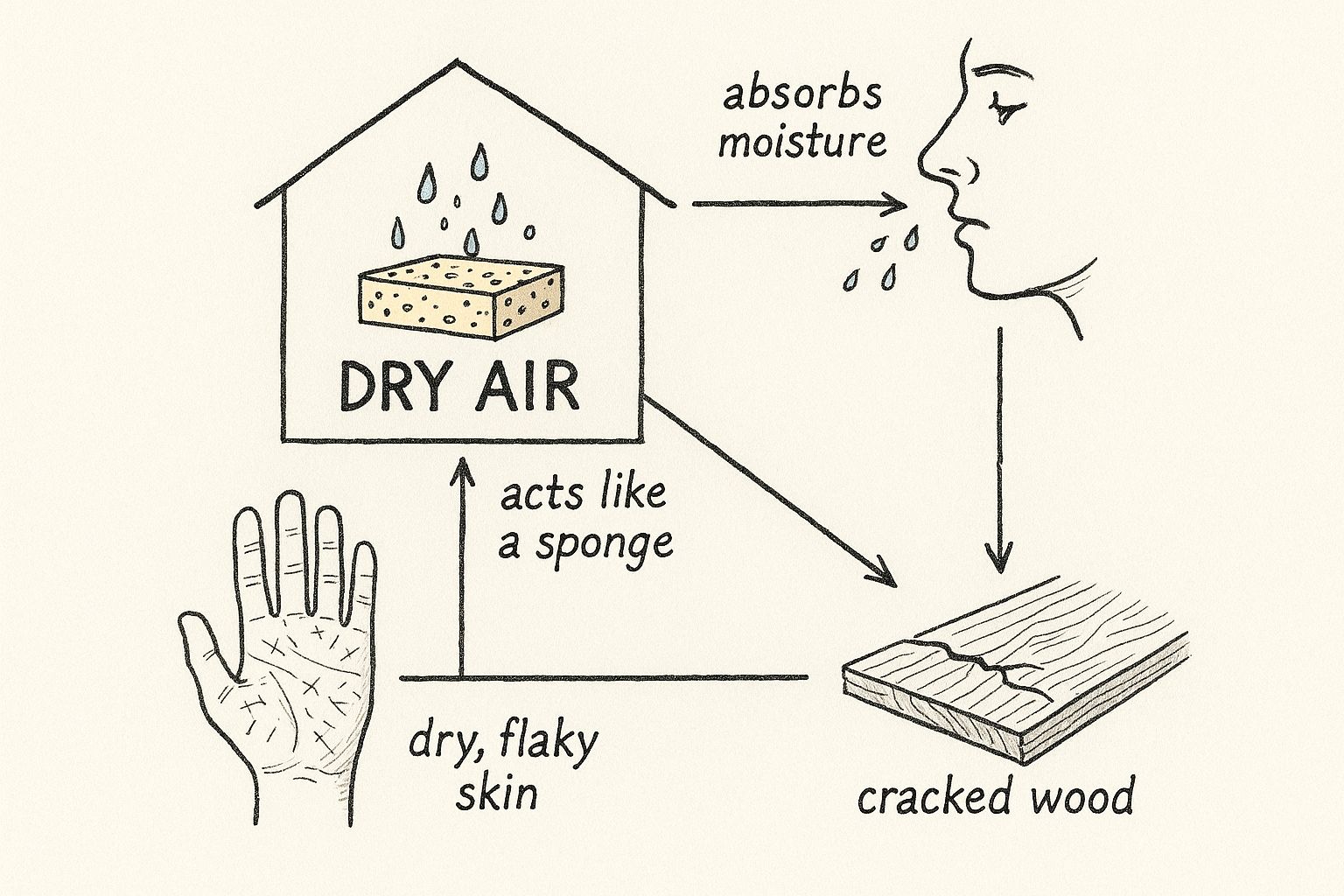
It’s a great visualization of the direct link between low humidity and all those common household problems, from personal discomfort to actual property damage.
The Growing Awareness of Air Quality
People are finally starting to pay serious attention to the air they breathe inside their homes. The global humidifier market was valued at about USD 4.73 billion in 2024, and it's on track to nearly double. That explosion shows a real shift in awareness about the health benefits.
This growth is coming from people just like you who are looking for relief from respiratory issues and dry skin. In fact, North America accounts for roughly 45% of all sales.
Here at Top Tech Mechanical, we're all about creating healthier living spaces for families across communities like Atlanta, Marietta, and Kennesaw. We specialize in complete indoor air quality solutions, from HVAC maintenance and duct cleaning to insulation. You can learn a lot more by reading our detailed guide on understanding indoor air quality for healthier homes and schools.
Decoding the Different Types of Humidifiers
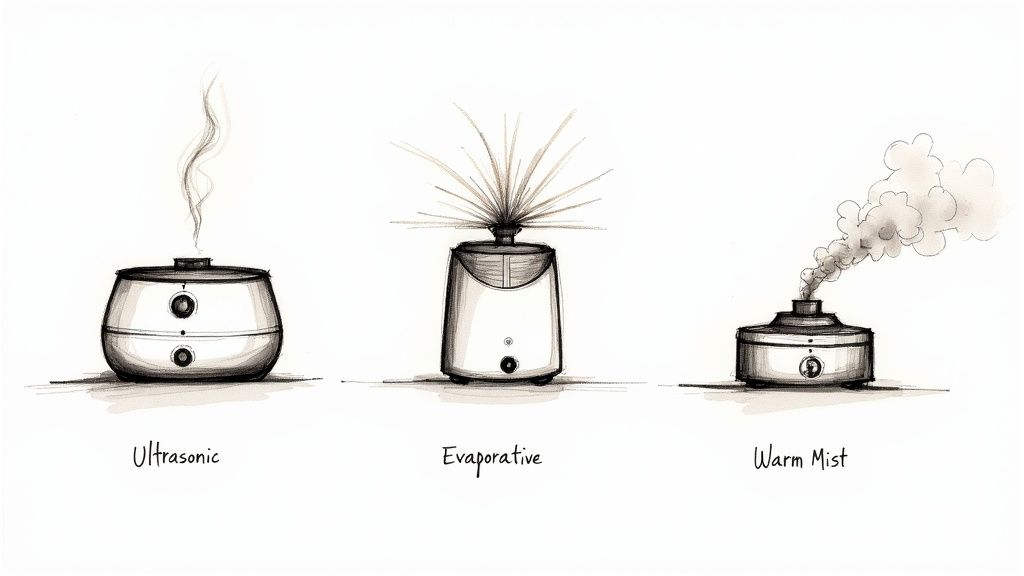
Walking into the humidifier aisle can feel a bit overwhelming, but it gets a lot easier once you realize that most models fall into three main camps. The key to finding the right fit for your home—whether you're in Marietta or Johns Creek—is understanding how each technology works.
Ultrasonic, evaporative, and warm-mist humidifiers all add moisture to the air, but they go about it in completely different ways. Your best choice will come down to what you value most, from noise levels to maintenance needs and whether you have little ones or pets around.
Let's break them down.
Ultrasonic Humidifiers: Silent Mist Makers
Think of an ultrasonic humidifier as a tiny, silent fog machine for your room. It uses a small, vibrating plate moving at incredibly high frequencies to break water droplets into a super-fine, cool mist. Since there are no fans or boiling parts, they run almost completely silently, making them a top pick for bedrooms and nurseries.
Their quiet operation is a huge reason they’re so popular. In fact, ultrasonic models command a massive 69% market share globally in 2024, and households account for about 77% of all humidifier sales. That tells you just how much families depend on them for comfortable air. You can read the full research about these humidifier market trends to see the data for yourself.
The only real catch is something called "white dust." Because the whole water droplet is turned into mist, any minerals from your tap water can end up settling on furniture. It's an easy fix, though—just use distilled water.
Evaporative Humidifiers: The Natural Approach
Evaporative humidifiers take a more natural route, working a bit like a gentle breeze over a lake. A fan pulls dry air from the room and pushes it through a wet wick filter. As the air passes through, it picks up moisture naturally and sends it back into your space.
This method is cleverly self-regulating. As your room's humidity rises, the air can't absorb as much moisture, so the evaporation process slows down automatically. This makes it almost impossible to over-humidify the space.
Key Takeaway: Because the water evaporates naturally, minerals are left behind in the filter, not dispersed into your air as white dust. This makes them a great option for homes with hard water.
The fan does create a low, consistent hum, but many people find it works well as white noise. Just remember to change the filter regularly to keep it running cleanly and efficiently.
Warm-Mist Humidifiers: Soothing Steam Vaporizers
Finally, we have warm-mist humidifiers, also known as vaporizers. These are the most straightforward of the bunch. An internal heating element simply boils the water, releasing a pure, warm steam into the room. This boiling process kills any waterborne bacteria or mold, so the mist you're breathing is completely sanitized.
That warm mist can make a room feel cozier, which is a fantastic perk during a chilly winter in Woodstock or Cumming. The trade-off is the heating element, which can be a burn risk for curious kids or pets. If you go this route, make sure to place it somewhere safely out of reach. They also tend to use a bit more electricity than their cool-mist cousins.
Humidifier Technology At a Glance
Feeling a little overwhelmed by the options? Don't be. This quick-glance table breaks down the key differences to help you zero in on the perfect technology for your home's needs.
| Feature | Ultrasonic | Evaporative | Warm-Mist (Vaporizer) |
|---|---|---|---|
| Noise Level | Virtually silent | Low hum from fan | Quiet gurgling/boiling |
| Mist Temperature | Cool | Cool | Warm |
| Energy Use | Very Low | Low | Higher |
| White Dust Risk | High (with tap water) | None | None |
| Filter Required? | No | Yes (wick filter) | No |
| Best For | Bedrooms, nurseries | Homes with hard water | Colds, congestion relief |
Ultimately, there's no single "best" type of humidifier—just the one that's best for you. Whether you prioritize silent operation for a good night's sleep or want a filter-free, sanitizing mist, one of these three technologies will be the right fit.
Sizing Your Humidifier for Perfect Performance
Picking the right humidifier is a lot like choosing a new air conditioner. If it’s too small, it won’t make a dent. If it's too powerful, you'll just trade dry air for damp walls and window condensation.
Getting the size right is easily the most important step for achieving that perfect, consistent humidity. In fact, a mismatched unit is one of the most common mistakes we see homeowners make.
An undersized humidifier will run nonstop, burning through electricity while it struggles to hit the target. On the other hand, an oversized model can quickly push your room’s moisture level above 50%, creating a perfect breeding ground for mold and mildew. The key is to match the humidifier's output capacity—usually measured in gallons per day—to the square footage of your space.
Matching Capacity to Room Size
For portable units, manufacturers give you pretty clear guidelines to find the right fit. Every home’s layout is different, of course, but these general rules are a great starting point.
- Small Rooms (Up to 300 sq. ft.): Think bedrooms, nurseries, or a home office. A small, compact unit with about a 0.5-gallon daily capacity is what you're looking for.
- Medium Rooms (300 to 500 sq. ft.): This is your sweet spot for living rooms or master bedrooms. You’ll want a mid-sized humidifier that can put out 1 to 1.5 gallons of moisture each day.
- Large Rooms (500 to 1,000 sq. ft.): For big, open-concept areas or large basements, you’ll need a console-style unit or a beefier tabletop model with a capacity of at least 2 gallons per day.
A correctly sized humidifier should be able to maintain your desired humidity without constantly running on its highest setting. If it’s working that hard, it’s probably too small for the room.
The Ultimate Solution: Whole-House Humidification
Portable units are great for hitting specific rooms, but they come with the chore of constant refilling and cleaning. For homeowners in communities like Woodstock, Kennesaw, and across the greater Atlanta area, the most effective and hassle-free solution is a whole-house humidifier.
Our team at Top Tech Mechanical installs these systems directly into your central HVAC system. They work hand-in-hand with your furnace or air handler, delivering perfectly balanced humidity to every single room in your home through your existing ductwork. This integrated approach is a game-changer.
- Set-It-and-Forget-It Convenience: It hooks right into your home’s water line, so you can say goodbye to daily tank refills for good.
- Total Home Comfort: You get consistent humidity everywhere, from the living room to the bedrooms, protecting both your family’s health and your home's wood floors and furniture.
- Improved Energy Efficiency: Properly humidified air actually feels warmer. That means you can lower your thermostat a few degrees in the winter and save on your heating bills.
As specialists in indoor air quality and heating installation, we can help you choose and install a system that provides effortless, balanced humidity all year long. It's the ultimate upgrade for total home comfort.
Essential Features That Make a Real Difference
Once you've picked a technology—ultrasonic, evaporative, or warm-mist—the real magic is in the details. Certain features are what separate a frustrating appliance you have to babysit from one that seamlessly improves your home's comfort.
Getting these details right means you're investing in a machine that's convenient, healthy, and efficient. This checklist will help you cut through the noise and focus on what truly matters for your home.
The Non-Negotiable Humidistat
If there's one feature you absolutely should not skip, it's a built-in humidistat. Think of it as the thermostat for your humidifier. It's constantly reading the room's humidity and automatically turns the unit on or off to maintain your target level.
Without one, you're just guessing. You could easily push the moisture level well past 50%, creating the perfect breeding ground for mold and mildew—the exact opposite of what you want. A good humidistat takes the guesswork out of the equation.
Convenience and Health Features
To make sure your humidifier is a helpful tool and not just another chore, look for these practical features. They make all the difference in day-to-day use.
- Easy-to-Fill Tank: A bigger tank means fewer trips to the sink. Top-fill designs are a game-changer, letting you pour water right in without taking the whole thing apart.
- Filter Change Indicators: For evaporative models, this little light is a lifesaver. It tells you exactly when the wick filter is done, so you're not left wondering if the unit is running cleanly.
- Easy-to-Clean Design: Look for wide tank openings and simple parts. The last thing you want is a humidifier with a bunch of nooks and crannies that are impossible to clean.
- UV-C Light Sanitization: Some higher-end models use a built-in UV-C light to zap bacteria and mold in the water before it ever becomes mist. This adds a fantastic layer of protection for your family. If you're curious about how this tech works in other systems, checking out the pros and cons of UV light in HVAC can give you some great context.
Pro Tip: For a bedroom or nursery, an ultra-quiet "sleep mode" is a must-have. It usually dims the display lights and runs the fan on its lowest setting so it won't disturb anyone's sleep.
When you choose a model with these thoughtful features, you're not just buying a humidifier. You're making a smart investment in a more comfortable and healthier home.
Keeping Your Humidifier Clean for Healthy Air
Bringing a good humidifier into your home is a great move for your family's comfort, but it comes with one non-negotiable rule: you have to keep it clean. If you don't, that helpful appliance can quickly become a problem, spreading mold, bacteria, and other gunk into the very air you’re trying to improve.
Think of it this way: you wouldn't keep drinking out of the same unwashed glass day after day. The same idea applies to the water tank in your humidifier. A simple, consistent cleaning schedule is the only way to make sure the unit is doing its job safely and effectively.
Your Weekly Cleaning Routine
You don't need a lot of time—just a few minutes once a week will do the trick. A quick clean-out prevents mineral buildup and other grime from taking over.
Here’s a simple process to follow:
- Unplug and Disassemble: First things first, safety. Unplug the humidifier and dump any old water from the tank and base.
- Descale with Vinegar: Pour a mix of one part white vinegar and one part water into the tank. Swish it around so it coats everything, then let it sit for 20-30 minutes. This will break down all that chalky mineral scale.
- Clean Small Parts: While the tank is soaking, dip a small brush in the vinegar solution and scrub the base and any other little nooks and crannies where residue likes to hide.
- Rinse Thoroughly: Dump the vinegar solution and rinse every part with clean water until the vinegar smell is completely gone. Let everything air-dry before you put it back together.
The Importance of Water Quality
If you’re constantly dealing with mineral scale or a fine layer of "white dust" on your furniture, your tap water is likely the culprit. Getting a better understanding of hard water can make a world of difference for your maintenance routine and the air you breathe.
Key Insight: Using distilled or demineralized water is the single best thing you can do to prevent mineral buildup and white dust. It’s an extra step, sure, but it means less scrubbing and cleaner air in the long run.
For those with evaporative humidifiers, don't forget about the filter. A dirty, clogged filter can’t do its job and eventually becomes a breeding ground for mold. Always check the manufacturer's guidelines and swap it out on schedule. It’s a small task that ensures your humidifier is putting out nothing but clean, healthy moisture.
Get Total Home Comfort with Top Tech Mechanical
Now you've got the rundown on choosing a good humidifier, but true indoor comfort often goes beyond a simple portable unit you plug into the wall. While those tabletop models are great for a single bedroom, a whole-house humidifier is the real, set-it-and-forget-it solution for your entire home. And that’s where bringing in a pro makes all the difference.
At Top Tech Mechanical, we specialize in integrating these advanced air quality systems right into your home’s existing HVAC unit. Imagine having perfect humidity in every single room—from the basement hangout to the upstairs bedrooms—without ever thinking about refilling a tank or messing with settings again. Our NATE-certified technicians make the whole installation process seamless.
Your Local Indoor Air Quality Experts
We serve communities all over the Atlanta metro area, from Canton and Cumming to Dallas and Marietta, so our team knows the unique climate challenges we face here. Our goal is to provide complete solutions that go way beyond just humidification. For instance, while a humidifier adds moisture back into the air, you might also be thinking about how to get rid of dust, pollen, and other gunk. Our guide on the best whole-house air purifiers can help you build a truly healthy home environment.
A professionally installed whole-house humidifier doesn't just make your home feel better—it can actually help your HVAC system run more efficiently, which could mean lower heating bills in the winter.
We’re all about delivering total home comfort, and we do it through a whole range of expert services for both homes and businesses:
- AC and Heating Services: From AC repair and heating maintenance to complete AC installation and heating replacement.
- Commercial HVAC: We handle commercial AC repair, commercial heating repair, and commercial rooftop replacement HVAC and RTU installs.
- Indoor Air Quality Services: Our expertise covers duct cleaning, dryer vent cleaning, insulation, and water heater installation.
Ready to finally stop dealing with dry, uncomfortable air and get your home perfectly balanced? Give Top Tech Mechanical a call today for a professional consultation. We’ll help you find the best solution for year-round health and comfort.
Your Humidifier Questions, Answered
Even after covering the basics, you probably still have a few questions rolling around. That’s perfectly normal. We hear the same ones from homeowners all the time, whether we're in Acworth, Marietta, or Sandy Plains.
Let's clear up some of the most common questions so you can feel confident you're making the right call for your family's comfort.
What Is the Ideal Humidity Level for a Home?
The sweet spot for comfort and health is keeping your home's indoor humidity between 30% and 50%. Drop below that range, and you'll start noticing dry skin, scratchy throats, and annoying static electricity.
But if you creep above 50%, you’re creating an inviting environment for mold, mildew, and dust mites to thrive. This is why a quality humidifier with a built-in humidistat is so handy—it takes the guesswork out and automatically maintains that perfect balance.
Can a Humidifier Really Help with Allergies and Asthma?
Yes, it absolutely can. Adding a bit of moisture to the air does wonders for soothing irritated nasal passages and airways, which can make breathing a lot more comfortable for allergy and asthma sufferers.
Proper humidity also has a neat side effect: it helps airborne allergens like dust and pollen get heavy and fall out of the air faster, so you're not breathing them in.
Important Note: This only works if your humidifier is clean. A dirty unit can do more harm than good by blowing mold or bacteria into the air, which is the last thing you want for someone with respiratory issues.
What Is That White Dust All Over My Furniture?
If you're seeing a fine white powder settle on your tables and shelves, you're looking at mineral residue from hard tap water—something we have plenty of here in Georgia. This is almost always a sign that you're using an ultrasonic or impeller humidifier.
While it’s generally harmless, it can be a real pain to clean up. The best way to stop it is to switch to distilled or demineralized water in your humidifier's tank. Or, you could opt for an evaporative model, which cleverly traps those minerals in a wick filter so they never make it into your air in the first place.
For a lasting, whole-home solution to indoor air quality, trust the experts at Top Tech Mechanical. We provide professional HVAC installation, repair, and maintenance services across the greater Atlanta area, from Kennesaw and Woodstock to Roswell and Milton. Contact us today to achieve total home comfort.