

An Energy Star HVAC system isn't just a fancy name—it's a heating and cooling unit that's been proven to meet or exceed the rigorous energy efficiency standards set by the U.S. Environmental Protection Agency (EPA). It’s not a brand, but a powerful seal of approval. This certification signals that the system is engineered to keep your home comfortable while using less energy, leading directly to lower utility bills and a smaller carbon footprint.
Decoding The ENERGY STAR Label
Think of the blue ENERGY STAR label on an HVAC unit like the MPG sticker on a new car. It's a straightforward, government-backed promise that you’re getting top-tier efficiency for your money. For homeowners here in Kennesaw, Marietta, and across the greater Atlanta area, choosing a certified system is one of the smartest upgrades you can make for your home’s comfort and your wallet.

That little blue label means the equipment is designed to perform better while drawing less power. The EPA sets very specific benchmarks, and manufacturers have to meet them to earn the certification. It’s a way of making sure these systems truly represent the best in energy-saving technology.
The Science Behind the Savings
So, how exactly does an Energy Star HVAC system pull this off? The secret is in its advanced components and much higher efficiency ratings. To really get it, you just need to know the key metrics that measure performance.
- SEER2 (Seasonal Energy Efficiency Ratio 2): This rating is all about cooling efficiency. The higher the SEER2 number, the less energy your air conditioner needs to cool your home. Certified systems have to meet a minimum SEER2 rating that's way above what standard models offer.
- HSPF2 (Heating Seasonal Performance Factor 2): This one applies to heat pumps and measures how efficiently they heat your home. Just like SEER2, a higher HSPF2 rating means bigger energy savings during those chilly months in places like Woodstock and Canton.
By choosing a system with high SEER2 and HSPF2 ratings, you're essentially getting more bang for your buck—more heating and cooling power for every dollar you spend on electricity.
The core promise of an ENERGY STAR system is simple: it works smarter, not harder. Instead of just blasting away and wasting energy, it uses advanced technology to precisely match your home's needs, giving you consistent comfort while keeping running costs low.
For families in bustling communities from Roswell to Sandy Plains, this efficiency translates into real, tangible benefits. An old, clunky HVAC system can be a huge drain on your budget, especially during Georgia's sweltering summers and surprisingly cold winters. Upgrading to a certified unit means you'll not only feel more comfortable but also see a real drop in your monthly energy bills. It's an investment that truly pays for itself over time.
So, How Do These Systems Actually Maximize Your Savings?
The impressive performance of an Energy Star HVAC system isn't some kind of magic. It all comes down to smarter technologies working together to eliminate energy waste. Instead of the old "all-or-nothing" approach most of us are used to, these units are designed to be highly responsive and adaptive. That’s the real key to maximizing your savings.

This efficiency comes from a few advanced components that standard systems just don't have. For homeowners here in Woodstock and Canton, understanding how these features work shows you exactly why an upgrade leads to such a noticeable drop in your monthly power bills.
Variable-Speed Motors: The Cruise Control for Your Home
One of the biggest energy-savers is the variable-speed motor. Think of a traditional HVAC system like a car with only two settings: stop and full throttle. It blasts cold or hot air until it hits the target temperature, then shuts off completely. This constant starting and stopping is a massive energy drain.
A variable-speed motor, on the other hand, operates more like your car's cruise control. It adjusts its speed up or down in tiny increments to precisely match what your home needs at any given moment. This allows it to run for longer periods but at a much lower, steadier speed.
This continuous, low-power operation has some major perks:
- Drastic Energy Reduction: The motor uses way less electricity than a standard one that’s constantly kicking on and off at full blast.
- Consistent Temperatures: It gets rid of those uncomfortable temperature swings, keeping every room in your house consistently comfortable.
- Improved Air Filtration: Since the air is circulating more often, your system’s filter gets to do its job better, which means cleaner indoor air for your family.
Advanced Compressors and Smart Integration
Beyond the motor, Energy Star HVAC systems also use superior compressors and integrate seamlessly with smart thermostats. The compressor is the heart of your AC unit, and these certified models use highly efficient designs that simply require less energy to cool your home.
When you pair that with a smart thermostat, the entire system becomes a responsive, intelligent network.
By constantly analyzing data and making tiny adjustments on the fly, these systems prevent energy waste before it even happens. This smart operation is what truly separates an ENERGY STAR unit from a basic appliance.
This matters a lot, especially when you consider that in 2023, residential air conditioning usage in the South hit 93%. Homes with ENERGY STAR appliances typically see energy savings of 15% to 20% on heating and cooling costs—a significant reduction for any family’s budget.
To really get the most out of your system, it helps to understand your utility's time-of-use electricity rates. When you combine efficient technology with smart usage habits, the savings potential gets even bigger.
Calculating Your Potential Savings and ROI
Efficiency ratings are great, but let's be honest—what really matters is how those numbers translate into dollars saved. Figuring out your potential savings is how you see the real return on investment (ROI) when you upgrade to an Energy Star HVAC system. The financial payoff comes down to a few key factors specific to your home and where you live.
Several things will influence how quickly you start seeing that money back in your pocket. We have to look at the age and inefficiency of your current system, local electricity rates right here in the Atlanta area, and even how well your home is insulated. A home in Cumming with a 15-year-old clunker of an AC unit is going to see a much bigger drop in utility bills than a newer home in Dallas with a system that's already halfway decent.
Estimating Your Annual Cost Reduction
The difference in operating costs between an old, energy-guzzling unit and a modern ENERGY STAR model can be pretty staggering. Older systems often have to run constantly just to keep up, which means they're burning through energy and driving up your bills month after month.
This chart really puts it into perspective, showing how a more efficient system directly cuts down your annual energy spending.
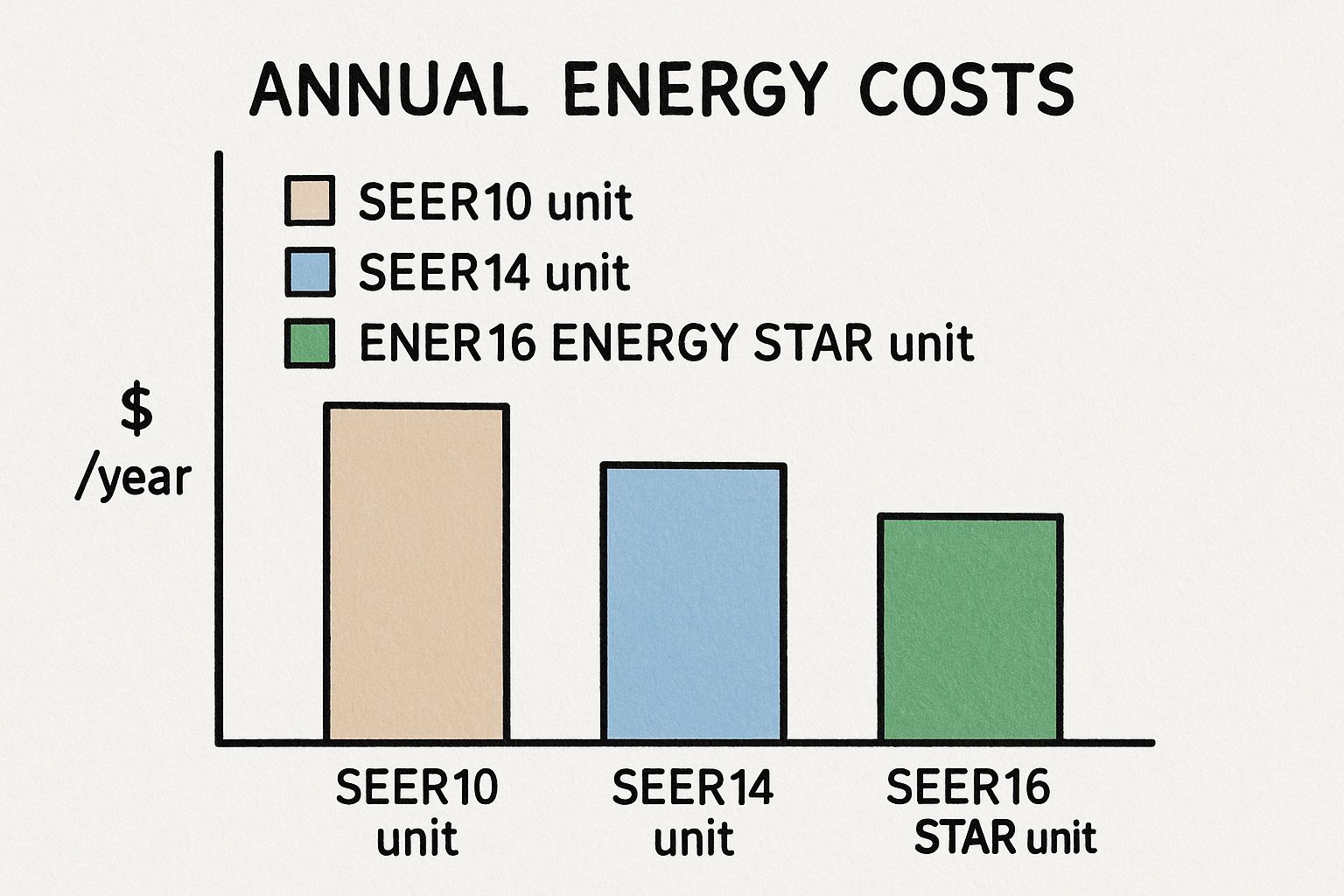
As you can see, jumping from an ancient SEER 10 unit to a modern SEER 16 ENERGY STAR model could literally cut your yearly cooling costs in half.
To give you a clearer picture, here’s a breakdown of what you might expect to save each year by upgrading.
Estimated Annual Savings with an ENERGY STAR HVAC Upgrade
This table compares the potential annual energy cost savings when upgrading from an older HVAC system to a modern ENERGY STAR certified unit in a typical single-family home.
| Old System SEER Rating | New ENERGY STAR SEER2 Rating | Estimated Annual Savings |
|---|---|---|
| 10 SEER | 16 SEER2 | Up to $550 |
| 12 SEER | 16 SEER2 | Up to $350 |
| 10 SEER | 18 SEER2 | Up to $650 |
| 12 SEER | 18 SEER2 | Up to $450 |
Keep in mind, these are estimates. Your actual savings will depend on your home's unique characteristics, but this gives you a solid idea of the financial impact an upgrade can have.
Understanding Your Return on Investment
Return on investment is just a straightforward way of figuring out how long it takes for your energy savings to "pay back" the initial cost of the new system. Yes, a high-efficiency unit might have a higher price tag upfront, but the long-term savings often make it the smarter financial move.
You can get a rough idea of your ROI with a simple formula:
(Total Upfront Cost – Rebates & Credits) / Estimated Annual Savings = Payback Period in Years
Let's walk through a real-world scenario for a homeowner here in Cartersville.
- Upfront Cost: $8,000 for a new ENERGY STAR heat pump installation.
- Rebates/Credits: $1,500 in combined federal and local incentives.
- Net Cost: $6,500.
- Annual Savings: $600 (compared to their old unit).
Plugging that into the formula, we get $6,500 / $600 = 10.8 years. This means the system essentially pays for itself in just under 11 years.
When you consider that modern Energy Star HVAC systems can easily last 15 to 20 years, you're looking at many years of "free" comfort after that payback period. That's not even counting the immediate boost in home value and, of course, better comfort from day one. It makes the upgrade a powerful long-term financial play.
Unlock Rebates and Tax Credits to Lower Your Cost
A high-efficiency Energy Star HVAC system is a fantastic investment, but let's be honest—the price tag can look a little intimidating at first. The great news is you don’t have to shoulder that cost alone. There are a ton of financial incentives out there specifically designed to make these energy-saving upgrades easier on your wallet.
For families in Acworth, Vinings, or anywhere in the greater Atlanta area, these programs can seriously cut down the upfront investment. It makes getting a top-tier system a much more achievable—and financially smart—choice that starts paying you back right away.
Navigating Your Incentive Options
Think of these incentives as a team effort between you, the government, and your utility company to boost energy efficiency. They’re set up to reward you for making a smart choice that helps your bank account and the planet.
You'll generally find three main types of financial help:
- Federal Tax Credits: The government often offers big-time tax credits for installing qualifying high-efficiency heating and cooling equipment. These credits aren't just deductions; they directly reduce the amount of tax you owe, which is a huge win.
- Local Utility Rebates: Companies like Georgia Power frequently give direct rebates to customers who upgrade to energy-saving appliances. These are straight-up cash-back offers that lower your final cost right off the bat.
- Manufacturer Promotions: HVAC manufacturers sometimes run their own specials and rebates on their premium Energy Star certified models, giving you another way to save.
Knowing how to find and stack these offers is the key to getting the best possible deal. For homeowners in our service areas, from Marietta to Johns Creek, Top Tech Mechanical can help you hunt down every single incentive you qualify for.
How to Find and Apply for These Programs
Chasing down the right programs can feel like a bit of a scavenger hunt, but the savings make it totally worth the effort. Eligibility is usually tied to the system’s efficiency ratings (like SEER2 and HSPF2), so picking a qualifying model is the most important step.
The Energy Star program has a massive positive impact, which is why these incentives get so much support. In fact, since it started, the program has helped prevent about 1.6 billion metric tons of greenhouse gas emissions. That's a big deal.
The application process usually just requires you to submit proof of purchase and installation documents. Here at Top Tech Mechanical, we walk our clients through this all the time, making sure you have all the right paperwork to claim your money. For a detailed look at what's available right now, check out our guide on Georgia HVAC tax credits. This way, you can be sure that a new Energy Star HVAC system isn't just an upgrade for your comfort, but a sharp financial move, too.
Choosing the Right System for Your Georgia Home
Picking out a new HVAC system isn't like buying an off-the-shelf appliance. It’s a decision that has to be tailored specifically to your home, and getting it right is the single most important step for years of comfort and low energy bills, whether you're in Powder Springs or Roswell.
So, where do we start? With a professional load calculation. You might hear it called a Manual J calculation, and it’s not just a recommendation—it's absolutely essential. We dig into the details: your home's square footage, the number and type of windows, insulation levels, and even our local Georgia climate, all to figure out the exact heating and cooling power you need.
Why Sizing Is So Important
Getting the size wrong is a recipe for disaster. If a unit is too small, it'll run nonstop trying to keep up, and you'll see it on your power bill. But a system that's too big is just as bad. It will short-cycle, constantly kicking on and off. This wreaks havoc on the components and, even worse, it never runs long enough to pull the humidity out of the air, leaving your home feeling clammy and uncomfortable.
A professional load calculation prevents these costly sizing mistakes. It ensures you invest in a system that’s perfectly matched to your home, delivering years of peak performance and optimal energy savings without compromise.
Matching the System to Georgia’s Climate
Here in Georgia, we have our own unique weather challenges—hot, sticky summers and pretty mild winters. That means certain types of Energy Star HVAC systems just make more sense for homeowners in Kennesaw and Marietta.
- Heat Pumps: Honestly, these are fantastic for our climate. They work like a standard AC in the summer, but then they reverse the process to provide efficient heat in the winter. It’s a great all-in-one solution.
- High-Efficiency Furnaces and ACs: If you prefer to keep your heating and cooling separate, you can't go wrong pairing a high-efficiency natural gas furnace with an ENERGY STAR certified air conditioner. This combination delivers powerful, reliable comfort no matter the season. Check out our guide to energy-efficient cooling systems to learn more about this kind of setup.
Getting familiar with ratings like SEER2 (for cooling) and HSPF2 (for heating) will help you compare different models like a pro. When you combine that knowledge with an expert load calculation from us at Top Tech Mechanical, you’ll have everything you need to choose a system that keeps your family comfortable for a long, long time.
It's no surprise that homeowners everywhere are catching on. The demand for efficient HVAC technology is skyrocketing, with the market projected to hit over $505 billion by 2035, largely because people are choosing certified, high-performance systems.
Why Professional Installation And Maintenance Matter
https://www.youtube.com/embed/l-GP2sPOf-E
An Energy Star HVAC system is a seriously impressive piece of equipment, but all that advanced technology is only as good as its installation and upkeep. Think of it like a high-performance sports car; you wouldn't let just any mechanic tinker under the hood, right? The same goes for your HVAC—a professional, certified technician isn't just a good idea, it's non-negotiable.
So many things can go wrong during installation. Simple mistakes, like an incorrect refrigerant charge or leaky ductwork, can absolutely cripple your system's efficiency from day one. That new, high-efficiency unit you invested in suddenly has to work overtime, completely wiping out your expected energy savings and paving the way for early breakdowns. For homeowners in Kennesaw, Marietta, and our surrounding communities, choosing a trusted pro is the first real step toward getting the value you paid for.
Safeguarding Your Investment With Routine Care
Once your system is installed perfectly, the focus shifts to keeping it that way. Regular maintenance isn't just another chore on the list; it's the single best way to protect your investment, maximize your savings, and guarantee comfort for years to come. The HVAC market is booming—projected to hit $577 billion by 2030—because of these advanced, efficient technologies. But they need proper care to deliver on their promises.
A little bit of upkeep goes a long way.
- Change Your Filters: This is the easiest and most important thing you can do. A clogged filter chokes your system, restricting airflow, causing strain, and tanking your indoor air quality. Make it a habit to check it monthly.
- Get Annual Professional Tune-Ups: Having a certified technician from Top Tech Mechanical inspect, clean, and tune your system annually helps catch small issues before they snowball into expensive, mid-summer emergencies.
Proper maintenance ensures your ENERGY STAR system actually operates at the super-efficient levels promised on the sticker. Skipping it is like knowingly letting your savings leak out of your wallet every single month.
Understanding the whole picture is key. It's not just about picking the right system; it's about committing to its long-term health. As detailed in A Homeowner's Guide to AC Services and Maintenance, professional care is what unlocks lasting efficiency. To see exactly how this impacts your bottom line and comfort, check out our article on the benefits of HVAC maintenance.
Common Questions About ENERGY STAR HVAC Systems
Making the switch to an Energy Star HVAC system is a pretty big decision, and it's smart to have questions before you jump in. To help you feel completely confident, we've pulled together some straightforward answers to the questions we hear most often from homeowners in Kennesaw, Marietta, and our other service areas.
Think of this as your final checklist. It’s here to confirm you’re making a great move for both your home's comfort and your wallet.
Are ENERGY STAR HVAC Systems A Lot More Expensive?
While it’s true that certified systems can have a higher price tag upfront, the difference is often smaller than you might think, especially once you factor in rebates and tax credits. The real story isn't about the initial price—it's about the total cost of ownership over the life of the system.
Those significant monthly energy savings add up quickly and often cancel out the higher initial cost, making an ENERGY STAR HVAC system the more affordable choice in the long run. You're not just buying a machine; you're investing in lower bills for years to come.
Is It Worth Upgrading to ENERGY STAR in an Older Home?
Absolutely. In fact, older homes in places like Roswell or Woodstock often see the biggest and most immediate improvements. That's because they're usually saddled with inefficient, outdated systems and might have issues with insulation.
A new, properly sized ENERGY STAR unit can dramatically boost your comfort while slashing the energy waste that's been inflating your bills. For the best results, we often suggest pairing the new HVAC system with other fixes like air sealing or adding more insulation. When you do that, you create a powerful one-two punch for maximum efficiency.
How Do I Know a System Is Actually ENERGY STAR Certified?
This one’s easy. Always look for the official blue ENERGY STAR logo right on the equipment itself and check its yellow EnergyGuide label. If you want to be extra sure, you can even look up the model number using the certified product finder on the official ENERGY STAR website.
A reputable contractor like Top Tech Mechanical will always give you clear documentation confirming the certification for any unit we install. We make sure you get exactly what you paid for—a genuinely efficient system that delivers on its promises.
Ready to see what an Energy Star HVAC system could do for your home in Acworth, Canton, or anywhere in the greater Atlanta area? The team at Top Tech Mechanical is here to provide expert services like AC Installation, AC Repair, Heating Repair, Indoor Air Quality solutions, and Commercial HVAC services to lock in your comfort and savings. Contact us today for a free, no-obligation consultation!